
A Gallerist in Florence: Meeting David at the Accademia
Some works of art you've seen so many times on postcards, fridge magnets and tea towels that you assume the real thing can't surprise you. I was wrong about David.
The Walk Towards Him

You don't meet David straight away at the Galleria dell'Accademia. You walk towards him. A long vaulted hall draws you forward past the crowds, and at the far end, framed by grey stone columns and lit from a glass dome above, he stands on his own. Even from the far end of the room, over a sea of raised phones, he holds the space.
The Figures Still in the Stone


Before you reach David, you pass what turned out to be my favourite part of the visit. Lining the corridor are Michelangelo's Prigioni, the Prisoners, which he carved for the tomb of Pope Julius II and never finished.
They're extraordinary because they're incomplete. A torso twists out of a raw block. An arm is raised against a mass of stone that hasn't yet become a head. You can still see the grid of chisel marks where Michelangelo was working the surface down, layer by layer. He believed the figure already existed inside the marble and that his job was to set it free. Here you can watch that happening, frozen halfway.
We usually only get to see the finished piece. These show the struggle behind it, and I found them more moving than anything else in the building.
David, Up Close
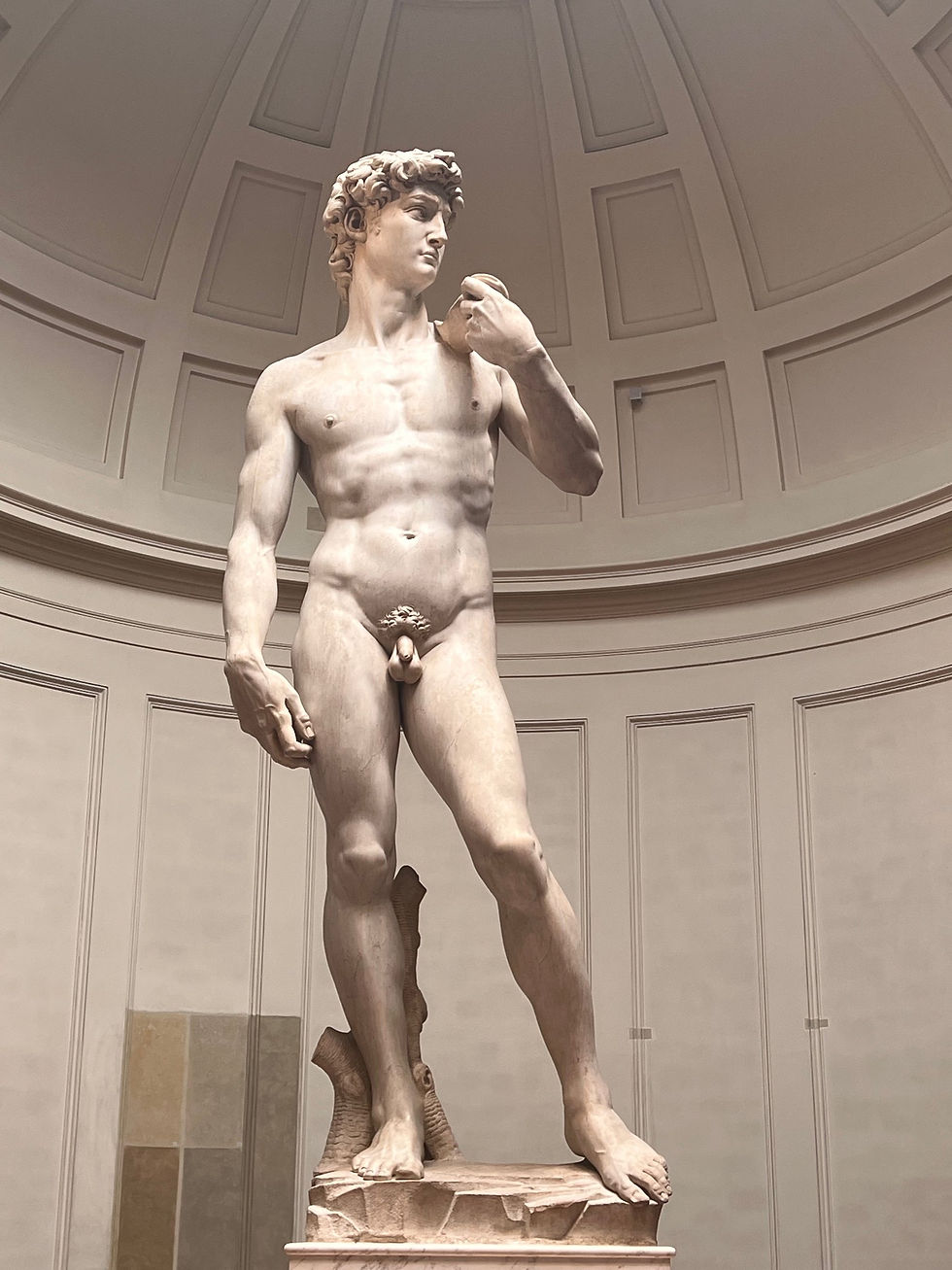
Then the corridor opens into the Tribune, the domed room built in the nineteenth century purely to house him. David was moved indoors from the Piazza della Signoria in 1873 to protect him from the weather, and a copy now stands in his original place outside the Palazzo Vecchio.
Nothing prepares you for the scale. He's over five metres tall, carved between 1501 and 1504 from a single block of Carrara marble that other sculptors had started and abandoned as flawed. Michelangelo was in his mid-twenties when he took it on.
This isn't the triumphant David of earlier sculptures, standing over Goliath's head. Michelangelo shows the moment before the fight: weight on one leg, sling over the shoulder, the stone held loosely in his right hand.

Look at the face. The brow is furrowed, the eyes are fixed on something far away, and the veins stand out on his hand. This is a young man weighing up his odds.

Walk round him. From behind, set against the glass dome, he becomes a silhouette against the sky, with the sling strap running diagonally across his back. This was my favourite photograph of the whole day.
A Lesson in Display

Standing in the Tribune, I kept thinking about how much the setting does for the sculpture. The architects gave David his own room, natural light from above, a plain backdrop and a long approach that builds anticipation. A masterpiece crammed into a corner would still be a masterpiece, but it wouldn't stop you in your tracks.
It's the same principle, on a very different scale, that we think about when a client asks where to hang a new piece. Light, space and what surrounds a work change how it's seen. If you're weighing up where a painting should go at home, we're always happy to talk it through.
Beyond David

Off the main corridor, the Hall of the Colossus holds Giambologna's full-size plaster model for The Rape of the Sabine Women, the spiralling group whose finished marble stands in the Loggia dei Lanzi. Around it hang Renaissance altarpieces, including Perugino's glowing Assumption. It's a reminder that the Accademia is much more than one statue.
If You Go
Book a timed ticket in advance, and aim for the first slot of the morning or the last of the afternoon. When you get inside, don't rush past the Prisoners on the way to David. Most people do, and they miss half the story.
Next from Florence: the Baptistery doors, Brunelleschi's dome, and the competition that started the Renaissance.
Discover more than 70 artists in our artist directory.


Comments