
A Gallerist in Florence: Under Brunelleschi's Dome
Every view of Florence seems to end at the same place. You turn a corner, glance down a side street or look out of a hotel window, and there it is: that great terracotta dome, sitting over the city like it has always been there. It hasn't. Six hundred years ago, nobody knew how to build it.
A Façade Younger Than It Looks

The cathedral is dazzling in the morning sun, clad in white Carrara, green Prato and pink Maremma marble. The pattern runs around every wall, every apse and every window.

Stand close and it's the detail that gets you: twisted columns, inlaid stars and geometric borders cut and fitted by hand.

Here's what surprised me. The façade that looks so convincingly medieval was only completed in the 1880s. The original was never finished, and the front of Florence's cathedral stood bare for centuries. The great bronze doors came later still, around 1900.
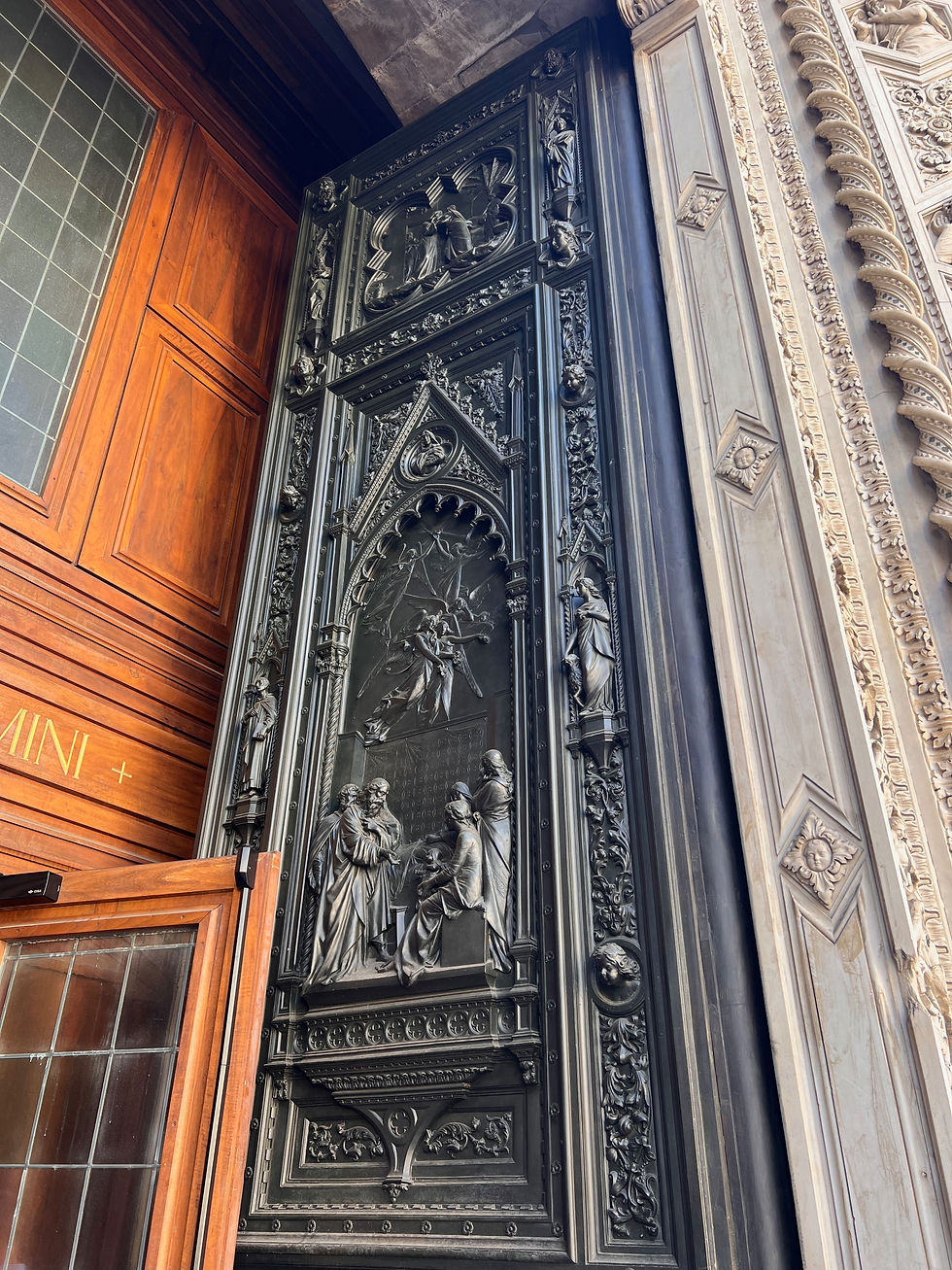
Look out for the mosaic over the north door, too. It's an Annunciation from 1490 by the Ghirlandaio brothers, and the date is set into the tiles.

One practical note: Giotto's bell tower is currently wrapped in scaffolding for restoration, so don't count on it for your photos.
The Doors That Started It All

Across the square, the Baptistery holds the story that explains everything else. These bronze panels, framed in quatrefoils and studded with lion heads, date from the 1330s.
In 1401 the city held a competition to make a second set of doors to match them. Every artist had to cast a trial panel of the same scene. The final two were a young goldsmith called Lorenzo Ghiberti and another called Filippo Brunelleschi. Ghiberti won. He spent the next two decades on those doors, and then another quarter of a century on a third pair, the golden doors Michelangelo reportedly called fit for the gates of Paradise.
Brunelleschi, by most accounts, took the loss badly. He turned away from sculpture towards architecture and went to Rome to study the ancient ruins. It turned out to be the best thing that could have happened to Florence.
The Impossible Dome

The cathedral had been built with a vast octagonal hole in the roof, and no one knew how to cover it. It was too wide for the timber scaffolding that normally held a dome up while the mortar set.
Brunelleschi's answer, begun in 1420, was two shells of brick, one inside the other, laid in a herringbone pattern so that each course held itself up as it rose. No supporting framework was used at all. It took sixteen years, and it's still the largest masonry dome ever built.
Standing underneath it, you don't think about engineering. You just look up.
The inside is covered by the Last Judgement, one of the largest frescoes in the world. Giorgio Vasari began it in 1572, and after his death Federico Zuccari finished it in 1579. Saints and angels crowd the clouds at the top, while down near the rim the damned tumble into a very inventive hell.
Inside the Cathedral
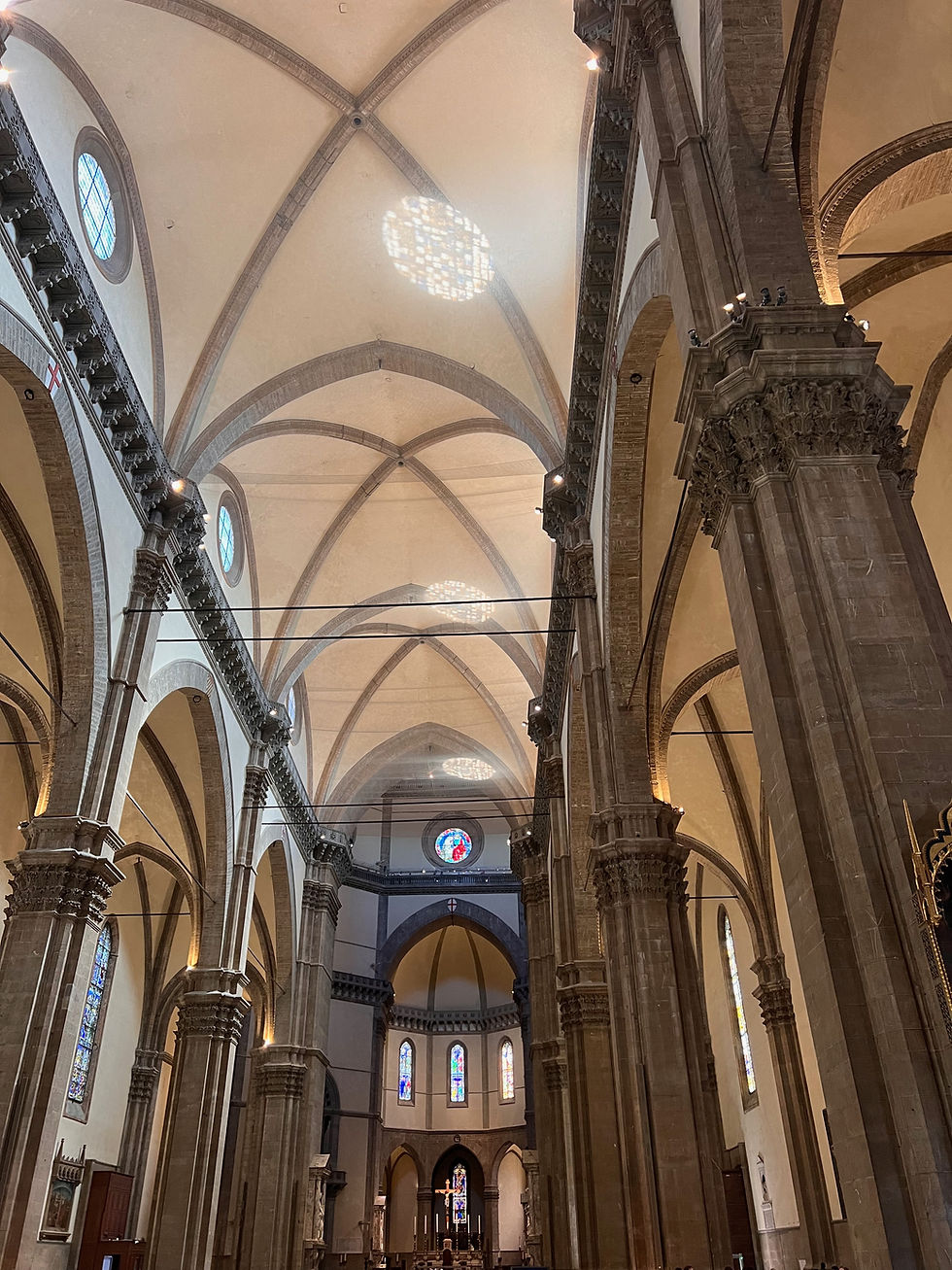
After the busy exterior, the interior is surprisingly plain: soaring grey stone, pale vaults and pools of coloured light from the rose windows drifting slowly across the ceiling.

Turn around and look back at the entrance wall for two treasures by Paolo Uccello. One is the clock, painted in 1443, which still runs on the old Italian system where the day ended at sunset, so its single hand moves the opposite way to ours. Along the left wall is his painted horseman, a memorial to Sir John Hawkwood, an English mercenary who fought for Florence. It's an unexpected bit of home.
The Apostle Michelangelo Never Finished
Around the crossing stand marble statues of the apostles, each in its own niche of richly veined stone. There's a story behind them that links back to our last post. In 1503 the cathedral commissioned Michelangelo to carve all twelve. He only got as far as roughing out St Matthew before other work, and a pope, called him away.
That unfinished St Matthew now stands in the Accademia, in the same hall as the Prisoners, still struggling out of the stone. The finished St Matthew here is a later replacement by another sculptor. I liked knowing that the figure we'd walked past the day before was meant to be standing right here.
A Man of Great Genius

The last stop was the one I keep thinking about. Down in the crypt, among the remains of the earlier church that once stood here, is a plain grey slab with a laurel wreath on it. It's Brunelleschi's grave.
He died in 1446 and was given the rare honour of burial inside the cathedral. Over the centuries his tomb was forgotten, and his bones weren't rediscovered until excavations in 1972. The original Latin inscription still reads, in translation, "the body of a man of great genius".
The man who lost the competition for the Baptistery doors is buried beneath the greatest dome in the world. I can't think of a better ending.
If You Go
Entry to the cathedral itself is free, but expect a queue. It's usually open from mid-morning to mid-afternoon, Monday to Saturday. The crypt, the dome climb and the Baptistery need a pass, and the dome climb needs a timed slot booked in advance. It's 463 steps with no lift, so plan accordingly.
It's the same principle at any scale: great work rewards a closer look. If there's a piece in our collection you'd like to look at more closely, we're always happy to talk.
Next from Florence: what the city taught me about living with art.


Comments